Investing Market Insights here - Cutting through the noise to show you what actually moves money.
What's on the menu today:
The Bitcoin Buying Machine Is Starting to Slow Down
Wall Street Is Flashing a Warning Signal Few Investors Want to See
Japanese corporate pension fund plans 1% crypto allocation: Nikkei

The Bitcoin Buying Machine Is Starting to Slow Down
One of the biggest Bitcoin bulls on the planet is suddenly facing a problem.
And it has nothing to do with Bitcoin itself.
It has to do with the machine that buys it.
Since launching its Bitcoin funding vehicle STRC last year, Strategy has used it as one of the key tools for raising money and buying more BTC.
The idea was simple:
Raise capital.
Buy Bitcoin.
Repeat.
Over and over again.
And for a while, it worked.
Really well.
Strategy now holds more than 846,000 Bitcoin.
That's a stash worth tens of billions of dollars.
But recently, something changed.
STRC was designed to trade close to its $100 value.
Instead, it has fallen as low as $82 and is currently trading well below that level.

STRC daily chart. Source: TradingView
That matters because the entire model works best when investors are eager to buy the product.
When STRC trades below its target value, raising fresh capital becomes much harder.
And that can slow Bitcoin purchases.
We're already seeing signs of that.
Earlier this year, Strategy was buying billions of dollars worth of Bitcoin in a matter of weeks.
Recently?
Purchases have shrunk dramatically.
Instead of multi-billion-dollar buying sprees, the company has been adding closer to $100 million worth of BTC at a time.

Still significant.
But nowhere near previous levels.
The controversy is getting louder too.
Critics argue the structure depends heavily on attracting new investor capital to keep the flywheel spinning.
Supporters argue that's completely missing the point.
They say STRC's drop has more to do with leverage getting wiped out than any fundamental problem with Strategy itself.
And there is some logic there.
Many investors treated STRC almost like a stable income product.
When the price started falling below expectations, forced selling and margin liquidations accelerated the decline.
Basically:
Too much leverage.
Too many people assuming the price couldn't fall.
Then reality showed up.
What's interesting is that the lower STRC falls, the higher the effective yield becomes.
At current levels, buyers are earning yields around 13%.

Source: X/Scott Melker
That's starting to attract a different type of investor looking for income rather than Bitcoin exposure.
So the market may eventually find a new equilibrium.
The bigger story here isn't really about STRC.
It's about how dependent Strategy's Bitcoin accumulation strategy has become on capital markets.
For years, the company looked unstoppable.
Issue securities.
Raise money.
Buy Bitcoin.
Repeat.
Now investors are getting a glimpse of what happens when one part of that machine starts slowing down.
The takeaway:
Strategy is still the largest corporate Bitcoin holder in the world.
But this situation is a reminder that even the most aggressive Bitcoin accumulation strategy ultimately depends on investor demand.
And when that demand weakens, the flywheel starts spinning a little slower.

Wall Street Is Flashing a Warning Signal Few Investors Want to See
Wall Street is getting uncomfortably expensive again.
And history says that usually ends one of two ways:
A long period of sideways returns.
Or a painful correction.
Right now, the stock market keeps making new highs.
The S&P 500.
The Nasdaq.
The Dow.
They've all pushed higher this year despite inflation concerns, geopolitical uncertainty, and plenty of reasons to be nervous.
What's driving it?
A few major themes:
• AI optimism is still running hot
• Quantum computing excitement is growing
• IPO activity is back
• Companies are buying back record amounts of stock
• Corporate earnings have largely held up better than expected
So far, investors have happily ignored the risks.
But there's one metric flashing a warning sign.
The Shiller P/E ratio.
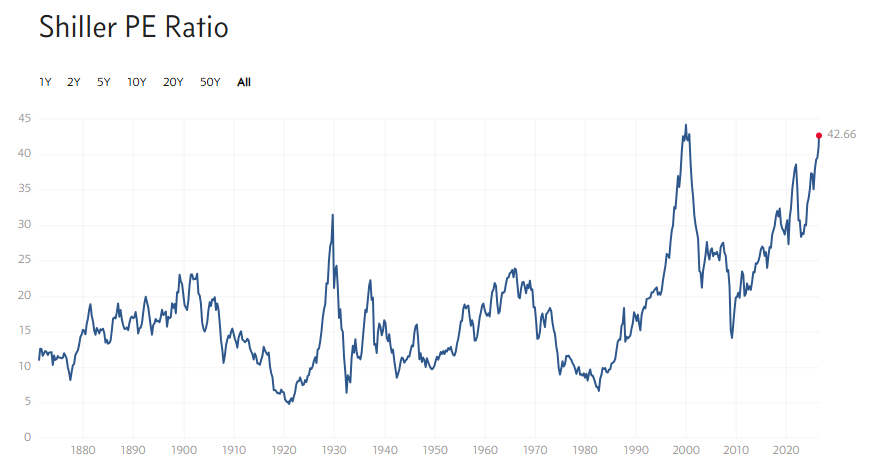
Think of it as a long-term valuation tool that compares stock prices against inflation-adjusted earnings over the past decade.
Unlike a normal P/E ratio, it smooths out short-term noise and gives a bigger-picture view of whether stocks are expensive or cheap.
Right now?
It's sitting around 43.
That's an eye-popping number.
Historically, the market has only reached levels above 40 a handful of times.
One was during the dot-com bubble.
Another was briefly in early 2022.
Neither period ended particularly well for investors.
The reason this matters is simple:
The higher valuations go, the less room there is for disappointment.
When stocks are priced for perfection, even small problems can trigger big selloffs.
The interesting part is that nobody knows exactly when that happens.
Markets can stay expensive longer than most people expect.
And powerful trends like AI can keep pushing valuations higher than what seems reasonable.
But history suggests that extremely rich valuations rarely last forever.
Now before everyone starts panic-selling everything...
There's another side to this story.
Bear markets feel awful while they're happening.
But they tend to be much shorter than bull markets.
Over the past century, bull markets have lasted several times longer than bear markets on average.

And if you zoom out even further, something even more interesting appears:
Over every rolling 20-year period in modern stock market history, investors who stayed invested ended up ahead.
Recessions.
Wars.
Inflation spikes.
Crashes.
Bubbles.
The market eventually recovered and moved higher.
That's the part most people forget during periods of fear.
The takeaway:
The stock market looks expensive.
Maybe even dangerously expensive.
That doesn't guarantee a crash tomorrow.
But it does suggest investors should prepare for more volatility ahead.
Because while valuations can stay elevated for a while...
History shows they don't stay elevated forever.

The Reality Check
DISCLAIMER: None of this is financial advice. This newsletter is strictly educational and is not investment advice or a solicitation to buy or sell any assets or to make any financial decisions. Please be careful and do your own research.